
Best Smart EV Chargers UK 2026
Compare smart home EV chargers by the features that can make a real difference: automatic scheduling, electricity-tariff integration, app control, solar charging, load management, connectivity and how the charger behaves as part of your wider home-energy setup.
There is no single smart EV charger that is automatically best for every UK home. Ohme Home Pro is particularly relevant where tariff-aware charging is a priority. myenergi zappi GLO puts solar and wider household energy management close to the centre of its smart proposition. Hypervolt Home 3 Pro combines app-led control, scheduling, solar charging modes and automatic load management.
Easee One and Pod Point Solo 3S provide different connected charging approaches with app control and energy-management features. The right choice depends on which of those functions you will actually use.
A strong shortlist candidate where automated charging around supported electricity tariffs is one of the main reasons for buying a smart charger.
Read our Ohme Home Pro guide →Particularly relevant where smart charging needs to respond to solar surplus, household energy use and changing energy conditions.
Read our zappi GLO guide →Combines app control with scheduling, automatic load management and solar-oriented charging modes.
Read our Hypervolt Home 3 Pro guide →What should a smart EV charger actually do?
Smart EV chargers compared
This table focuses on meaningful smart-charging differences rather than simply counting the number of app features each manufacturer lists.
| Charger | Smart-control focus | Connectivity | Tariffs / scheduling | Solar / energy management |
|---|---|---|---|---|
| Ohme Home Pro | Ohme app plus charger controls | Connected smart-charging platform | Strong tariff-aware proposition with supported smart tariff integrations | Solar-compatible charging functions and power balancing on suitable installations |
| Hypervolt Home 3 Pro | Full app control and charging schedules | 2.4GHz Wi-Fi and Bluetooth LE | Scheduling plus supported direct smart-tariff integrations | Solar & Grid and Solar Only charging modes plus automatic load management |
| myenergi zappi GLO | myenergi app and home-energy ecosystem | Connected myenergi platform | Scheduling plus response to supported dynamic tariffs and demand-response events | Solar-surplus charging and dynamic home-energy management |
| Pod Point Solo 3S | Pod Home app | 2.4GHz Wi-Fi | App-based smart scheduling | Solar Only and Solar & Grid modes on suitable solar installations |
| Easee One | Easee app and remote controls | 2.4GHz Wi-Fi plus built-in cellular connectivity | Smart scheduling and connected charging controls | Load balancing and surplus-energy charging with the appropriate Easee Equalizer setup |
What does “smart EV charger” actually mean?
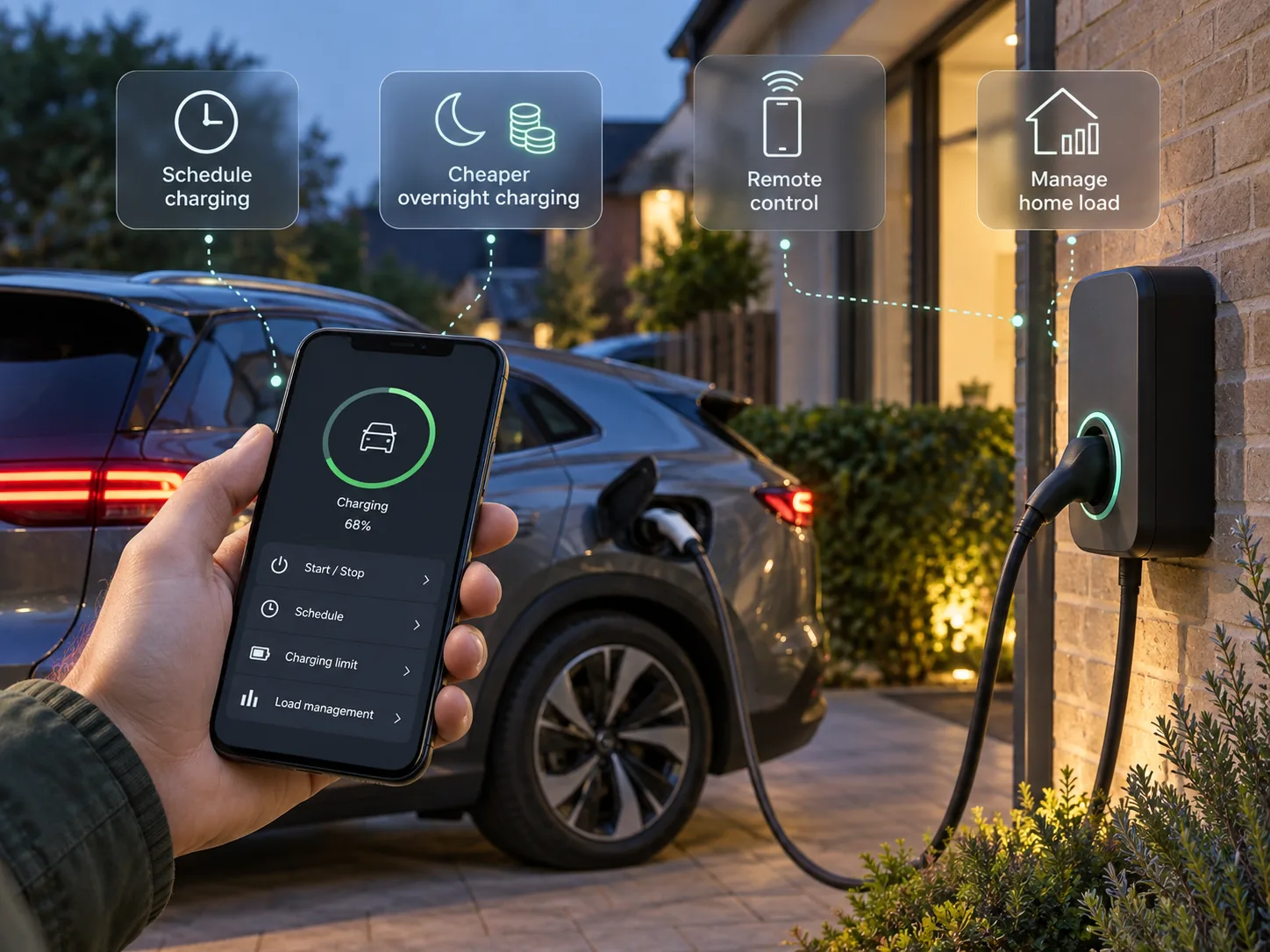
A mobile app is only one part of smart charging. The most useful smart chargers combine several different functions.
Scheduling
Set charging to happen during selected periods instead of charging immediately every time the car is plugged in.
Tariff-aware charging
Some chargers can work more directly with supported tariffs or supplier-managed charging services rather than relying only on a fixed timer.
Remote control
Check charging status, change settings or control charging through an app without standing beside the charger.
Load management
Charging power can be adjusted around the electricity being used elsewhere in the home.
Solar integration
Suitable chargers can respond to surplus household generation rather than treating the solar installation as an unrelated system.
Connected software
Apps, cloud services and firmware can add useful functions, but they also make connectivity and continued software support part of the buying decision.
Scheduling is not the same as tariff automation
Most modern smart home chargers can schedule charging. That does not mean every charger interacts with electricity tariffs in the same way.
Fixed schedule
You choose a charging window and tell the charger to operate during those hours.
This can work very well with an electricity tariff that has a predictable cheap period.
Smart-tariff automation
A supported charger, vehicle or supplier integration can make more automated decisions about when charging takes place.
The exact behaviour depends on the tariff and the equipment being integrated.
See our EV Tariffs UK comparison and off-peak electricity times guide before choosing hardware around an electricity tariff.
Ohme Home Pro
Ohme’s strongest smart-charging proposition is its emphasis on electricity tariffs and automated charging.
The Home Pro works with the Ohme app and supports charging schedules designed around the driver’s required charge and departure time.
Ohme also currently documents direct support for selected managed EV tariff services including Intelligent Octopus Go. Because tariff rules and integrations can change, confirm the current requirements before buying specifically for one tariff.
Why smart-charging households may shortlist Ohme
- Strong tariff-aware charging proposition
- Ohme app
- Automated charging schedules
- Supported smart-tariff integrations
- Solar-compatible charging functionality
- Power balancing
Particularly relevant if…
Your electricity tariff is central to the buying decision and you want charging times to be automated rather than manually changing schedules whenever your charging needs change.
Check current tariff compatibility separately from the charger hardware itself.
Hypervolt Home 3 Pro
Hypervolt Home 3 Pro combines app-based charging control with scheduling, automatic load management and solar charging modes.
Hypervolt’s current technical information documents Boost, Eco — Solar & Grid and Super Eco — Solar Only charging modes, alongside automatic load management.
Hypervolt also currently documents direct integrations with selected managed EV tariff services.
Smart features to consider
- Full app control
- Charging schedules
- 2.4GHz Wi-Fi
- Bluetooth LE
- Solar & Grid charging mode
- Solar Only charging mode
- Automatic load management
- Supported tariff integrations
Check the software as well as the hardware
Connected charger functionality can develop after installation through firmware, app and energy-provider integrations.
If a particular smart tariff or energy feature is essential, verify that specific feature immediately before ordering.
myenergi zappi GLO
The zappi GLO smart proposition is closely connected to household energy management rather than simply remote app control.
With Smart Charging enabled, myenergi currently documents that GLO can use surplus solar, follow charging schedules and respond to supported dynamic tariffs and demand-response events.
The myenergi app can also show energy flows between the grid, home, solar generation, batteries and connected equipment.
Why it may make the shortlist
- myenergi app ecosystem
- Solar-surplus charging
- Charging schedules
- Dynamic tariff support
- Home-energy monitoring
- Dynamic home-energy management
Particularly relevant if…
You already have solar panels, plan to install solar, or want the EV charger to become part of a broader home-energy-management system.
Solar is important enough to deserve its own buying decision rather than being treated as one checkbox in a general charger specification.
Pod Point Solo 3S
Pod Point Solo 3S uses the Pod Home app as the main connected interface for home charging.
Pod’s current app documentation also describes dedicated solar charging controls with Solar Only and Solar & Grid options.
Smart features to consider
- Pod Home app
- 2.4GHz Wi-Fi
- Scheduled charging
- Solar Only mode
- Solar & Grid mode
- Connected charging history and controls
Check Wi-Fi at the parking position
Smart features depend on suitable connectivity.
If the charger will be fitted on a detached garage or a long way from the home’s router, consider the actual Wi-Fi signal at the installation point before assuming indoor coverage will be sufficient outdoors.
Easee One
Easee One takes a software-led approach to home charging with control through the Easee app.
Current product documentation lists 2.4GHz Wi-Fi and built-in cellular connectivity. It also supports wider load-management and renewable-energy functionality when used with the appropriate Easee Equalizer equipment.
Smart features to consider
- Easee app
- 2.4GHz Wi-Fi
- Built-in cellular connectivity
- Remote charging control
- Dynamic load-management ecosystem
- Solar-surplus charging with an appropriate Equalizer setup
Compare the whole system
Some of Easee’s energy-management functionality relies on additional hardware rather than the charger alone.
If solar or advanced load management is important, compare the complete installed system and required accessories rather than only the charger box.
Smart EV chargers and off-peak tariffs
One of the main reasons to use smart charging is to move EV charging away from expensive electricity periods.
Charger schedule
The charger follows a fixed schedule that you create.
Charger integration
A supported charger or charger account integrates more directly with a tariff or energy provider.
Vehicle or supplier control
Some smart charging services can instead communicate with the vehicle or manage charging through the supplier’s own system.
Does every smart EV charger work intelligently with solar?
No. A charger can be described as smart because it has an app, scheduling and remote connectivity without having advanced surplus-solar control.
Solar-aware charging normally requires suitable monitoring so the system can understand whether the property is importing or exporting electricity.
If solar is central to your purchase, compare:
- Whether genuine surplus-only charging is supported
- The minimum surplus required before charging begins
- Whether additional CT clamps or monitoring hardware are required
- How the charger responds when solar generation falls
- How a household battery affects the system
- Whether solar and cheap overnight charging can work together
Load management can matter more than flashy app features
A home EV charger can be one of the largest electrical loads in a property.
Load management or power balancing can monitor household demand and adjust EV charging power when necessary.
Ask the installer what monitoring equipment is required, where it will be installed and whether load management is included in the quoted installation price.
What happens if your smart charger loses internet access?
This is one of the most useful questions to ask before choosing a connected EV charger.
Internet connectivity may be used for apps, remote control, tariff data, charging history, software updates and supplier-managed charging. Offline behaviour varies by charger and by feature.
Ask about fallback behaviour
- Can the charger still provide a normal charge?
- Do existing schedules continue to work?
- Which app features become unavailable?
- What happens to tariff automation?
- Does the charger reconnect automatically?
Think about the installation location
A charger on a detached garage or at the end of a long driveway may not receive the same Wi-Fi signal as devices inside the house.
Check the available connection methods before installation where connectivity is important.
How should you compare EV charger apps?
Screenshots and the number of menu options do not tell you whether an app is useful. Focus on the jobs you will perform regularly.
- Can you quickly see whether the car is charging?
- Can you create and change schedules easily?
- Can you view useful charging history?
- Can you override a schedule when you need an immediate charge?
- Can the household manage the charger appropriately?
- Are tariff and solar controls understandable?
- Can you see clearly when the charger is offline?
- Is manufacturer support available when connected features fail?
What to look for in a smart EV charger
Charging schedules
Basic off-peak scheduling should be straightforward even if you never use advanced tariff integration.
Tariff compatibility
Check your specific charger, vehicle, supplier and tariff combination rather than relying on a generic compatibility claim.
Connectivity
Consider where the charger will be installed and which connection methods are available there.
Load management
Find out how charging responds to high household demand and what monitoring hardware is required.
Solar functionality
Distinguish genuine surplus-solar control from basic compatibility with a solar-equipped property.
Offline behaviour
Understand what remains functional if internet or cloud access is temporarily unavailable.
App controls
Prioritise useful everyday controls rather than a long list of functions you may never use.
Software support
A connected charger depends partly on continued app, firmware and cloud-service support.
The physical charger
Smart functions do not replace cable length, charger location, tethering, installation quality or everyday convenience.
Which type of smart charger should you consider?
If smart tariffs matter most
Put tariff-aware products such as Ohme Home Pro on the shortlist, then verify compatibility with the exact tariff setup you plan to use.
If solar matters most
Look closely at zappi GLO and compare other chargers on their actual surplus-solar behaviour rather than the word “compatible”.
If app control matters most
Compare Hypervolt, Easee, Pod Point and the other candidates on both their current controls and their connectivity requirements.
If connectivity is difficult
Check the actual installation location and favour a setup with a suitable connection method and sensible fallback behaviour.
If household demand is high
Make load management and the installer’s monitoring arrangement a central part of the decision.
If you just want cheap overnight charging
Do not pay for unnecessary complexity. A reliable charger with straightforward scheduling may be all you need for a fixed off-peak tariff.
Compare the complete smart-charging system
Some smart functions rely on equipment beyond the charger itself. Solar monitoring, CT clamps, energy meters, load-management devices or connectivity work can affect the completed installation.
That is why the retail price of the charger box is not enough to compare true cost.
Our smart EV charger comparison methodology
EVChargerCost uses manufacturer product pages, technical documentation, installation guidance and our individual charger research when comparing smart-charging functions.
We focus on:
- app and remote-control functions;
- scheduled charging;
- documented tariff integrations;
- connectivity;
- load management;
- solar and wider home-energy functionality;
- installation dependencies;
- software and connectivity limitations;
- the difference between built-in functions and optional accessories.
We distinguish documented manufacturer functionality from subjective long-term app reliability. Unless explicitly stated otherwise, this guide should not be read as a claim that EVChargerCost has completed extended hands-on testing of every app, firmware version and cloud platform.
Smart EV charger FAQs
What is a smart EV charger?
A smart EV charger is a connected charge point that can manage charging through functions such as scheduling, app control, load management, tariff integration or wider energy controls. Exact features vary by model.
What is the best smart EV charger in the UK?
There is no universal winner. Ohme is particularly relevant to tariff-aware charging, zappi GLO to solar and home-energy management, while Hypervolt, Easee and Pod Point provide other combinations of app, connectivity and energy-management features. Choose according to the function you actually need.
Can a smart EV charger save money?
It can help move charging into cheaper electricity periods when used with a suitable tariff. Actual savings depend on the tariff, mileage, vehicle efficiency, charging pattern and how the charger is configured.
Is smart charging the same as setting a timer?
No. A timer or schedule simply controls when charging begins. More advanced smart charging may also use tariff information, supplier controls, household electricity demand or solar generation.
Can a smart EV charger automatically use cheap electricity?
Some chargers can work with supported tariffs or supplier-managed services, while others rely mainly on schedules you configure yourself. Check the specific charger, vehicle, supplier and tariff.
Does a smart EV charger need Wi-Fi?
Not always. Connectivity methods vary between products. Some use Wi-Fi, some include cellular connectivity and some support more than one method. Check what the specific model needs for its connected functions.
Will an EV charger still charge if the internet goes down?
Offline behaviour varies by product and by feature. Basic charging may remain possible while cloud-dependent app, tariff or monitoring functions become unavailable. Confirm fallback behaviour if this matters to your installation.
Can smart EV chargers work with solar panels?
Some can, but “smart” and “solar-aware” are not the same thing. Look for documented solar-surplus behaviour and check what monitoring hardware is required.
What is EV charger load management?
Load management monitors the electricity being used at the property and can adjust EV charging power to help keep demand within the available electrical capacity.
Should I choose an EV charger based on its app?
No. The app matters, but you should also compare connectivity, charging schedules, load management, tariff and solar requirements, installation, cable arrangement and support.
Compare the charger and the installation
Smart functionality can depend on the way the charger is installed. Tell the installer if you need tariff integration, solar charging, load management or reliable connectivity at a detached garage or distant parking position.
Sources
We prioritise manufacturer product pages, support documentation and technical information for smart-charging functionality.
- Ohme — Home Pro
- Ohme — Intelligent Octopus Go integration
- Hypervolt — Home 3 Pro
- Hypervolt — Home 3 Pro technical specification
- myenergi — zappi GLO
- myenergi — zappi GLO app functionality
- Pod Point — Solo 3S app user guide
- Easee — Easee One product sheet
- Easee — solar charging guidance
Guide reviewed 5 October 2026. Smart-charging features, apps, firmware, energy-provider integrations and manufacturer services can change after publication. Confirm any feature that is critical to your purchase before ordering.