
Best EV Chargers for Solar Panels UK 2026
Compare EV chargers for solar panels by the features that actually affect how much of your own generation reaches the car: surplus-solar charging, grid import, CT monitoring, battery interaction, solar-only modes, smart tariffs and the equipment required to make the system work correctly.
myenergi zappi GLO is the strongest solar-first proposition in our current comparison because surplus generation and wider home-energy management sit at the centre of the product.
Hypervolt Home 3 Pro is a strong alternative with Eco, Super-Eco and battery-aware solar charging options. Ohme Home Pro is particularly interesting for households that want to combine daytime solar with Ohme’s tariff-aware charging ecosystem.
Pod Point Solo 3S and Easee One also provide genuine surplus-solar functionality, but their modes, monitoring requirements and installation arrangements differ.
Built around surplus solar, grid import/export monitoring, batteries and wider home-energy management.
Read our zappi GLO guide →Offers Eco and Super-Eco solar modes plus a Battery-Safe option designed to help prevent unwanted home-battery drain.
Read our Hypervolt guide →Combines Ohme’s solar functionality with a strong tariff-aware smart-charging proposition.
Read our Ohme Home Pro guide →Solar EV charging at a glance
EV chargers for solar panels compared
These chargers take different approaches to solar integration. The important comparison is not whether the marketing page says “solar compatible”, but how the completed system detects and uses actual household surplus.
| Charger | Solar approach | Surplus-only option | Monitoring | Key distinction |
|---|---|---|---|---|
| myenergi zappi GLO | Smart charging follows surplus solar and home-energy flow | Solar-surplus operation forms a core part of the system | Home-energy / CT-based monitoring | Solar and wider energy management are central to the proposition |
| Hypervolt Home 3 Pro | Eco uses self-generation; Super-Eco avoids grid import | Yes — Super-Eco | Main CT required for surplus detection | Battery-Safe mode adds protection against unwanted battery drain |
| Ohme Home Pro | Solar Boost plus solar-focused charging options on eligible setups | Solar-only functionality depends on current eligibility, app and firmware support | Working CT clamp required | Strong combination of solar and tariff-aware charging |
| Pod Point Solo 3S | Solar Only and Solar & Grid | Yes | Correct solar setup and commissioning required | Adjustable grid top-up when solar is below the EV minimum |
| Easee One | Surplus Only and Limited Grid Usage | Yes | Easee Equalizer required | Solar functionality sits within a wider load-management system |
How does an EV charger use surplus solar?
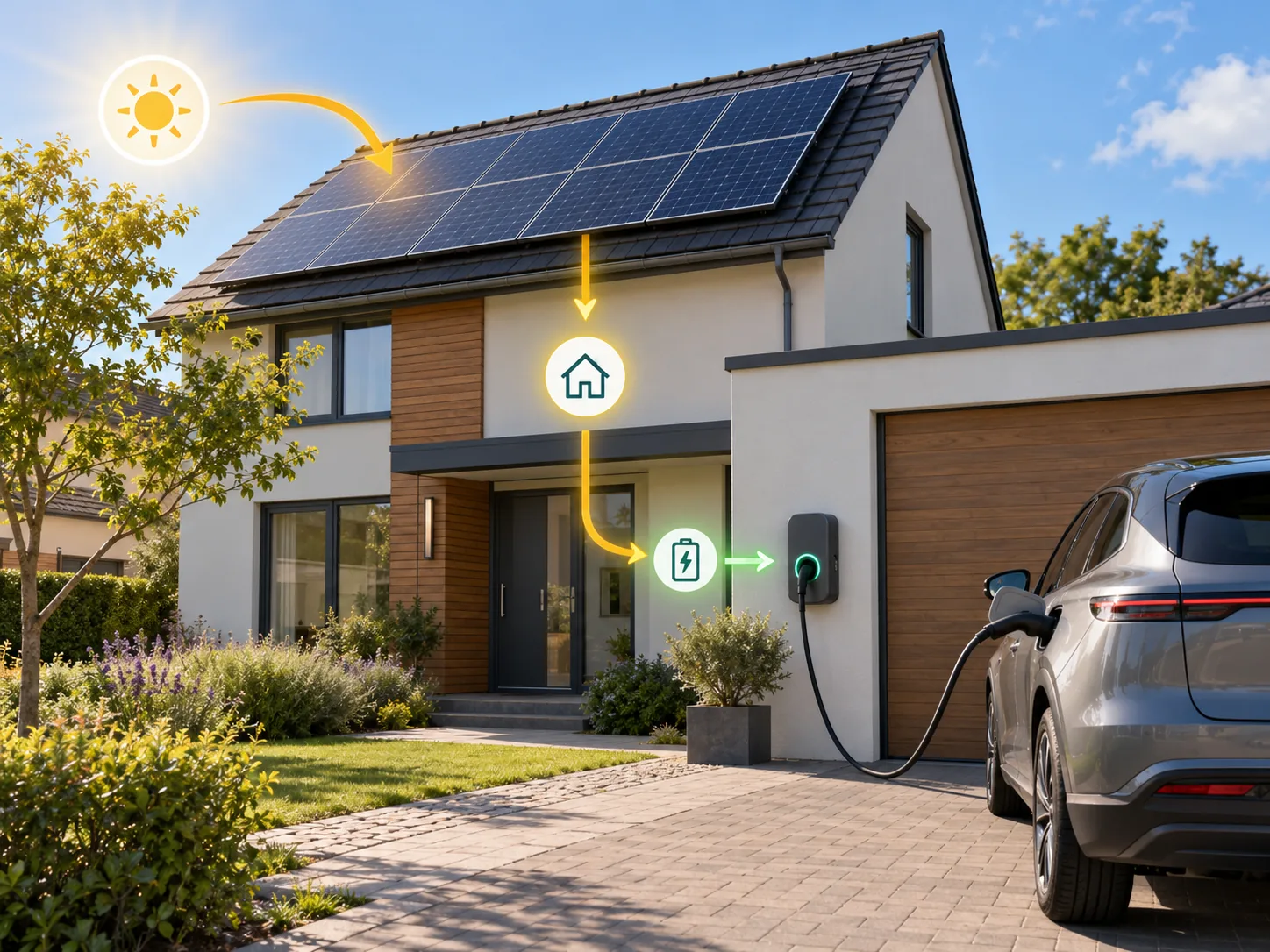
In a normal grid-connected UK home, the solar panels do not usually connect directly to the car. The PV system supplies the household electrical system. A solar-aware EV charger then uses energy monitoring to understand whether the property is importing electricity or exporting surplus generation.
1. Solar generates
Your PV system generates electricity and the home uses some of it for normal household loads.
2. Surplus is measured
Monitoring detects energy that would otherwise be exported to the grid.
3. Charging adjusts
The charger can raise, reduce or pause EV charging as the available surplus changes.
Why around 1.4kW matters for solar EV charging
An electric car cannot normally absorb an arbitrarily tiny amount of AC power. Many single-phase charging situations have a minimum current of around 6 amps, which is roughly 1.4kW at normal UK voltage.
If your property has only 500W or 800W of genuine solar surplus, a strict surplus-only mode may therefore have to wait rather than begin charging immediately.
Surplus-only mode
Charging waits until sufficient surplus is available. If the surplus falls below the charger’s or vehicle’s minimum requirement, charging may pause.
Solar + grid mode
The charger can supplement available solar with grid power to maintain the minimum charging rate.
myenergi zappi GLO
Solar is central to the zappi GLO proposition rather than being an optional afterthought.
With Smart Charging enabled, myenergi currently says zappi GLO can use surplus solar, follow schedules and respond to dynamic tariffs and demand-response events.
The system also continuously adjusts power according to grid import and export, tying EV charging into wider household energy management.
Why solar households may shortlist zappi
- Surplus-solar charging
- Dynamic grid import/export response
- Home-energy-management focus
- Solar and battery integration
- Smart tariff integration
- myenergi app ecosystem
Best suited to
Homes where the charger needs to become part of a wider energy system rather than simply charge the car from the grid.
This is especially relevant if you already have or plan to add solar PV, battery storage or other flexible home-energy equipment.
Hypervolt Home 3 Pro
Hypervolt gives solar households several clearly different charging behaviours.
Eco prioritises solar and home-battery energy and can use available self-generation above the minimum charging level.
Super-Eco is designed to charge from self-generated solar and battery energy without drawing electricity from the grid.
Hypervolt now also documents Battery-Safe, which builds on Super-Eco and is intended to pause charging if the home battery begins to discharge unintentionally.
Solar features to consider
- Eco solar charging
- Super-Eco surplus charging
- Battery-Safe mode
- CT-based surplus detection
- Automatic load management
- App-led charging controls
CT monitoring is essential
Hypervolt states that its main CT is required for solar charging because the charger needs it to detect surplus export.
Additional battery monitoring can be used with suitable systems, but AC-coupled and hybrid-inverter battery systems need to be treated differently.
Ohme Home Pro
Ohme is particularly relevant when you want solar charging to coexist with cheap electricity tariffs rather than treating solar and grid charging as two separate systems.
Ohme currently documents Solar Boost for eligible Home Pro and ePod installations. Solar Boost can use surplus solar while also using grid electricity where needed to meet the driver’s charging target.
Ohme also documents a more solar-focused mode that waits for sufficient excess generation before charging. Availability depends on the particular charger, app, firmware and eligible installation, so confirm the exact options visible on your setup before purchasing primarily for this feature.
Solar features to consider
- Solar Boost
- Surplus-focused charging options on eligible setups
- CT-based solar detection
- Tariff-aware smart charging
- Dynamic charging schedules
- Power balancing
Check battery behaviour
Ohme warns that its charger cannot necessarily distinguish electricity coming directly from solar from electricity being discharged by a home battery.
Battery owners should therefore check the battery’s own discharge settings if they want to prevent stored energy being used to charge the EV.
Pod Point Solo 3S
Pod Point’s current Solo 3S app documentation provides two clear solar choices: Solar Only and Solar & Grid.
Solar Only charges from excess solar once at least around 1.4kW is available. If the surplus falls below that level, charging pauses.
Solar & Grid allows grid electricity to supplement the available solar when the surplus is below the minimum charging threshold. The user can control how much grid import is allowed.
Solar features to consider
- Solar Only mode
- Solar & Grid mode
- Approximately 1.4kW solar-only threshold
- Adjustable maximum grid contribution
- Solar and grid usage shown in charging statistics
- Pod Home app
Useful if generation is variable
The Solar & Grid option is useful when your available solar frequently sits below the EV’s minimum charging power.
Instead of repeatedly waiting for more sun, the charger can add a controlled amount of grid electricity to keep the session running.
Easee One
Easee One supports automatic solar charging when used with the appropriate Easee Equalizer setup.
Easee currently provides two renewable-energy charging approaches: Surplus Only and Limited Grid Usage.
Surplus Only begins charging when enough renewable surplus is available to meet the charger’s minimum 6A requirement. Limited Grid Usage can supplement solar with grid power.
Solar features to consider
- Surplus Only charging
- Limited Grid Usage
- Easee Equalizer monitoring
- Dynamic load management
- App-based control
- Automatic charging-power adjustment
Compare the whole system
Easee’s solar functionality depends on the Equalizer rather than the charger operating alone.
Include that equipment and its installation when comparing total cost with a competing solar-charging system.
Solar compatible vs surplus solar charging
Solar compatible
At its broadest, this may simply mean a charger can be installed at a property that also has solar PV.
It does not automatically tell you whether the charger can detect export or adjust charging according to surplus generation.
Surplus solar charging
The system monitors household energy flow and adjusts EV charging in response to genuine surplus generation.
This is usually the more important capability if your aim is to increase direct use of the electricity generated by your panels.
What does a CT clamp do for solar EV charging?
A current transformer — usually shortened to CT clamp — allows an energy-management system to measure electrical current.
In a solar charging installation, one of the crucial measurements is normally the flow of energy at the property’s connection to the grid. This tells the system whether the home is importing electricity or exporting a genuine surplus.
Some installations need additional monitoring for battery storage or other energy equipment. What is required depends on the charger and the architecture of the home-energy system.
What if you have solar panels and a home battery?
Battery storage makes the decision more complicated because the battery and EV can both compete for the same surplus solar.
Battery first
You may want to fill the home battery first so that stored solar can cover expensive household electricity later.
EV first
If the car needs energy for an upcoming journey, diverting surplus to the EV first may make more sense.
Coordinated control
A well-designed energy system can use monitoring and control rules to manage charging priorities more deliberately.
Should you charge from solar or use a cheap EV tariff?
For many households, the most practical answer is both.
Solar and cheap overnight electricity solve different problems. Solar can reduce daytime grid imports when the car is at home. An off-peak tariff can guarantee cheap charging overnight when the vehicle needs more energy than the day’s surplus solar provided.
Check your import rate
How cheap is the electricity available during your EV tariff’s lowest-cost period?
Check your export value
How much would you be paid if the same unit of solar energy were exported instead?
Check battery value
Would storing the solar in your home battery avoid a more expensive grid import later?
What to look for in an EV charger for solar panels
Genuine surplus control
Does charging actively follow available surplus generation?
Solar-only behaviour
Can the charger avoid routine grid imports when sufficient solar is available?
Grid-assisted mode
Can grid electricity top up a weak solar surplus when you still need the car charged?
Minimum power
What happens when surplus generation drops below the minimum charging power required by the EV?
CT requirements
What sensors or meters are required and are they included in the installation quote?
Battery interaction
Can the system avoid accidentally discharging the home battery into the car?
Smart tariffs
Can solar charging coexist with cheap overnight charging?
App and monitoring
Can you understand how much energy came from solar and how the charger is behaving?
Installer knowledge
Does the installer understand solar, battery storage, CT placement and the charger-specific energy settings?
Compare the complete solar-charging installation
The charger box is only one component of a solar-aware charging system.
Depending on the property and product, the finished setup may also involve CT clamps, energy monitoring, communication wiring, connectivity, battery configuration and commissioning of the charger’s solar modes.
- Solar inverter type
- Home battery type and configuration
- CT clamp location and cable route
- Meter and consumer-unit position
- Load-management requirements
- Wi-Fi or other connectivity
- Solar-mode commissioning
- Battery and EV priority settings
Our solar EV charger comparison methodology
EVChargerCost prioritises manufacturer product pages, support documentation, technical manuals and installation guidance when comparing solar functionality.
We specifically look for:
- documented surplus-solar charging;
- solar-only and mixed solar/grid modes;
- minimum charging-power behaviour;
- CT clamp and monitoring requirements;
- grid import/export measurement;
- home-battery interaction;
- load management;
- smart-tariff integration;
- additional hardware and installation dependencies.
We do not treat every charger described as “solar compatible” as equivalent. The meaningful question is what the completed installation actually does with surplus generation.
Related EV charger guides
Best Home EV Chargers UK
Compare the complete home charger buying decision.
Compare home EV chargers →Best Smart EV Chargers UK
Compare apps, scheduling, tariffs and connected charging.
Compare smart EV chargers →Hypervolt Home 3 Pro
See Hypervolt’s solar, battery and smart features in detail.
Read Hypervolt guide →Ohme Home Pro
See how Ohme combines solar charging and tariff automation.
Read Ohme Home Pro guide →Pod Point Solo 3S
Review its Solar Only and Solar & Grid charging modes.
Read Pod Point Solo 3S guide →Solar EV charger FAQs
What is the best EV charger for solar panels in the UK?
There is no universal winner, but zappi GLO has one of the strongest solar-first propositions in our current comparison. Hypervolt Home 3 Pro is particularly interesting for solar plus battery control, while Ohme Home Pro combines solar charging with strong tariff-aware functionality.
Do I need a special EV charger if I have solar panels?
Not simply because the property has solar. However, if you want the charger to respond automatically to surplus generation, choose a charger and monitoring setup that specifically supports surplus-solar charging.
Can you charge an electric car directly from solar panels?
In a normal grid-connected home, the panels usually supply the household electrical system rather than connecting directly to the car. A solar-aware charger monitors energy flow and can use available surplus generation for EV charging.
Can a 7kW EV charger work with a smaller solar system?
Yes. The charger’s 7kW or 7.4kW figure is its maximum charging output. It can charge at lower power when the car, charger and solar mode support it.
Why does around 1.4kW matter for solar EV charging?
Many single-phase AC charging situations use a minimum current of around 6A, which is approximately 1.4kW. If surplus solar is below the required minimum, a surplus-only mode may pause while a mixed solar-and-grid mode can add grid electricity.
Can I charge an EV from solar panels on a cloudy day?
Potentially. Available solar may fluctuate, so charging behaviour depends on the genuine household surplus and whether the selected mode permits grid electricity to supplement it.
What does a CT clamp do?
A CT clamp measures electrical current. Solar charging systems commonly use CT measurements to determine whether the home is importing or exporting electricity so that the EV charger can react to genuine surplus generation.
Can a home battery interfere with solar EV charging?
Yes. Depending on the monitoring and control setup, a home battery may discharge while the EV is charging. Battery owners should decide how the system should prioritise the home battery, EV, solar generation, grid imports and exports.
Does Pod Point Solo 3S work with solar?
Yes. Pod Point’s current Solo 3S app documentation includes Solar Only and Solar & Grid charging modes.
Does Easee One work with solar panels?
Yes, when used with the appropriate Easee Equalizer setup. Easee currently supports Surplus Only and Limited Grid Usage renewable-energy charging modes.
Is it better to charge an EV from solar or cheap overnight electricity?
Often the best approach is to use both. Daytime surplus solar can reduce grid imports, while cheap overnight charging can guarantee enough energy for the next journey. The financially best combination depends on your import tariff, export payment, battery and charging pattern.
Tell the installer you need surplus solar charging
Do not simply say that the property has solar panels. Tell the installer if you specifically want the charger to react to surplus generation, work with a home battery, avoid grid imports or combine solar with a smart electricity tariff.
The monitoring and commissioning of the complete system can be as important as the choice of charger.
Sources
We prioritise manufacturer product pages, technical documentation, support guidance and installation instructions for solar-charging functionality.
- myenergi — zappi GLO
- Hypervolt — charging modes
- Hypervolt — CT clamps and automatic load management
- Hypervolt — home battery monitoring
- Ohme — Solar Boost and solar charging guidance
- Pod Point — Solo 3S app and solar charging guide
- Easee — Easee One product sheet
- Easee — surplus solar charging guidance
Guide reviewed 5 October 2026. Solar modes, firmware, apps, battery integrations and energy-provider services can change after publication. Confirm any feature that is essential to your installation before ordering.